Munitions and Fuses
Munitions and Fuses#
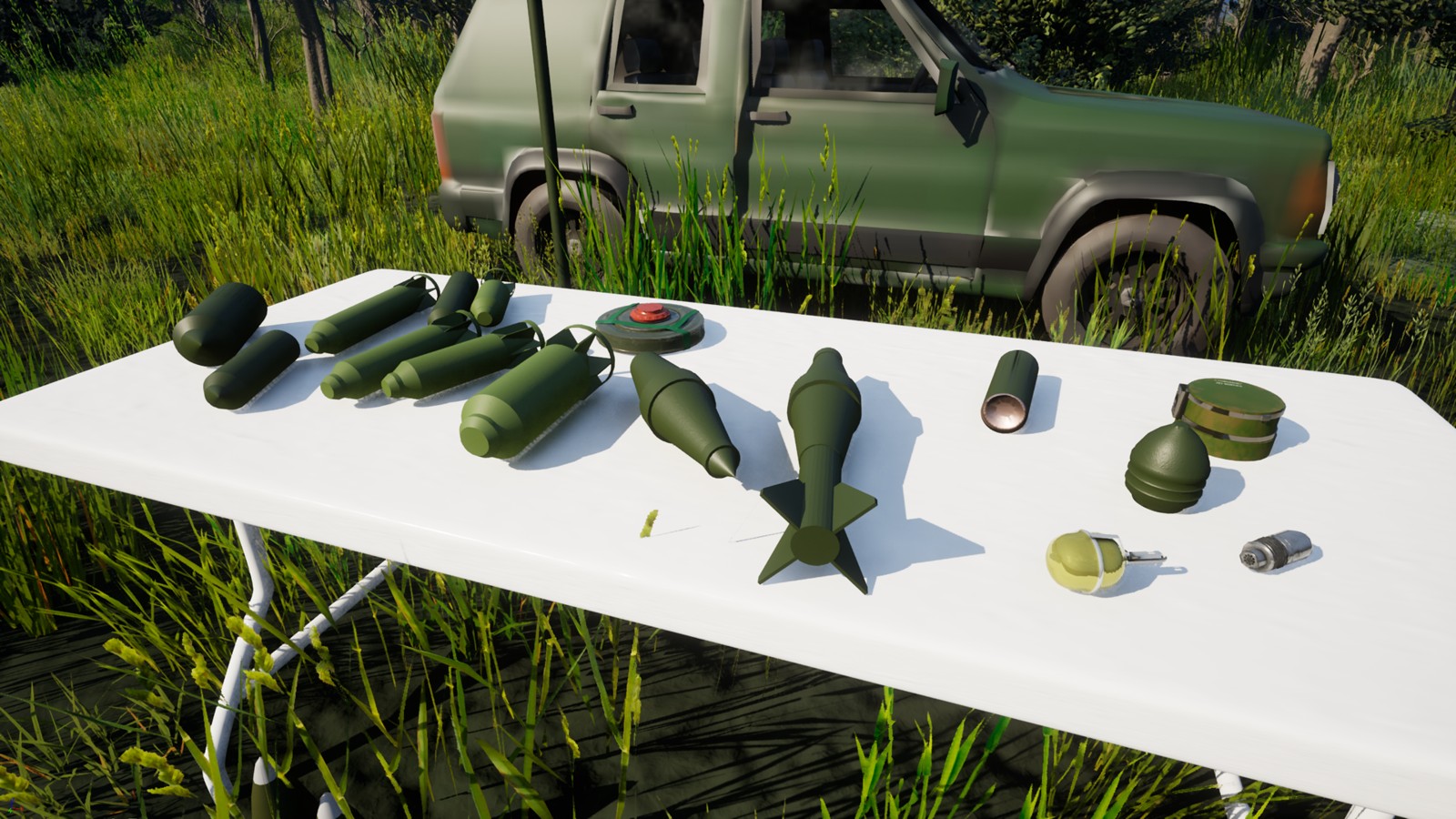
Explosives are one of the main elements in the life of drones. Most drones are tasked with either performing the strike or directly supporting another weapon system.
In Obriy, munitions consist of a warhead (there may be several) and a fuse.
Warheads#
Warning
Obriy currently uses a simplified penetration system that does not account for differences in armor thickness or the placement of critical and non-critical systems inside vehicles. Hits to the turret roof, turret ring, or the vehicle's side are more likely to penetrate.
When a munition explodes, penetration and damage are calculated. A hit with penetration guarantees a mobility kill, but usually, several hits are needed to completely destroy the target. A more powerful munition increases the chance of a catastrophic kill.
Fragmentation Damage#
Fragmentation warheads are the most common type. In Obriy, all damaging munitions are considered to have a weak fragmentation effect.
One defining feature of a warhead is its shape. Currently, Obriy supports cylindrical, spherical, and directional effects. Despite distinguishing between cylindrical and spherical effects, both currently emit fragments in a spherical pattern.
The fragment spread angle for a directional warhead is approximately 90 degrees.
Almost every munition generates a shockwave, which penetrates surfaces and can cause damage even behind obstacles. In practice, this is only useful for munitions weighing at least 2.8 kg.
Shaped Charges and Explosively Formed Penetrators (EFPs)#
Since it’s nearly impossible to damage armored vehicles with fragmentation munitions, special warheads are used to concentrate energy for effective armor penetration.
The most well-known warhead of this type is the shaped charge. The explosive energy is focused into a jet that can penetrate nearly any defense but loses effectiveness quickly with distance.
Obriy assumes that the energy of a shaped charge fully dissipates after 2 meters. It can penetrate a screen but loses much of its energy in the process. Moreover, the distance between the armor and the screen may be enough to fully disperse the jet.
An explosively formed penetrator (EFP) is a kinetic warhead that uses a directional explosion to form a high-velocity projectile capable of long-range armor penetration. Its downside is that it requires some distance to form properly. Thus, it is ineffective at point-blank range against armored targets.
Obriy assumes that the EFP forms at 5 meters and then travels 145 meters at full energy. Currently, it travels in a straight, non-ballistic trajectory. An unformed EFP can penetrate a BMP-3 but cannot pierce a screen or tank armor. A fully formed EFP can penetrate screens with barely any energy loss.
EFPs are considered one of the best options against tanks with improvised "barn" armor. Another, of course, is dropping a TM anti-tank mine on them.
Fuses#
Each munition is equipped with a custom fuse that does not necessarily match the standard fuse for that munition. For example, a VOG-25 can have a KD8 fuse or an electric match with a detonator initiation board.
Currently, Obriy supports four types of fuses:
Contact Fuse Without Safety#
The munition detonates on drone impact at a minimum speed of 7 m/s.
In reality, fuses usually have many safety layers, but this fuse exists in Obriy solely to allow kamikaze drones to strike immediately without configuring a software safety.
This is the only fuse that does not use a separate control channel.
Detonator Initiation Board#
A contact fuse that uses an additional channel from the controller. At 0% channel value, the fuse is fully inert. At 50%, it detonates upon impact at a minimum speed of 5 m/s. At 100%, it detonates immediately, allowing for airbursts.
When this fuse type is selected, a bomb channel appears in the controller settings. Proper channel setup is required for effective use.
Drop Fuse with Contact Detonation#
This fuse operates like a regular contact fuse (e.g., KD8) but includes a servo for dropping the munition. The munition detonates upon any impact above 7 m/s, so if the bombs remain mounted, the drone might explode during landing.
This fuse uses a servo channel for bomb release but has no additional safety mechanisms.
The drop mechanism takes approximately 0.3 seconds to activate.
Grenade Fuse Drop#
This is the only available fuse that cannot be activated by movement or impact. It also uses a servo mechanism. When the bomb is dropped, an UZRGM grenade fuze ignites, and the bomb explodes after 3.8 seconds.
This method offers greater control over the munition and makes it possible to drop bombs into dugouts or under trees, but it significantly limits the drop height. In practice, a drop from over 35 meters will result in an airburst.
This fuse uses a single control channel both to release the bomb and to activate the fuse itself.
The drop mechanism takes approximately 0.3 seconds to activate.
Munition List#
Fragment spread – the maximum distance at which fragments are lethal to infantry.
Warhead shapes "sphere" or "cylinder" are currently equivalent – cylindrical munitions also have uniform fragment spread in all directions. Some cylindrical munitions are labeled as having a spherical warhead due to chaotic or shapeless fragment dispersal patterns.
The last three columns indicate the munition’s ability to penetrate certain types of vehicles. One plus means it is possible; two pluses mean it works reliably and is the recommended (in the simulator) method of engaging that target.
"Screen" refers to any external armor spaced from the main vehicle, which diffuses shaped charge effects, fragments, and shockwaves, such as slat armor or "barn" improvised armor. Shaped charges may perform better or worse against screens depending on the free space behind them. One plus means the munition can damage an armored target through a screen; two pluses mean this is a recommended method for defeating a protected target.
Heavy fragmentation munitions are generally ineffective at penetrating screens and what's behind them, but multiple hits can destroy the protection, making it easier to hit the main target.
The artillery adjustment menu uses only 155mm munitions. While a direct hit from such a shell will definitely damage and likely destroy any armored vehicle, it is not the most efficient method against mobile or screened tanks.
The munition list below is current for version 0.7.4.
| Name | Fragments | Warhead Shape | BMP-3 | T-72 | Screen |
|---|---|---|---|---|---|
| Stabilized Fragmentation 800g | 12.7m | Cylinder | + | ||
| Stabilized Fragmentation 1.1kg | 16.1m | Cylinder | + | ||
| Stabilized Fragmentation 1.5kg | 18.0m | Cylinder | + | ||
| Stabilized Fragmentation 1.8kg | 20.5m | Cylinder | ++ | + | |
| Stabilized Fragmentation 2.8kg | 24.8m | Cylinder | ++ | ++ | |
| VOG-25 250g | 4.0m | Sphere | |||
| RGD-5 310g | 6.0m | Sphere | |||
| Shaped Charge 800g | 4.0m | Sphere | ++ | + | |
| Shaped Charge with Frag 1.1kg | 12.7m | Sphere | ++ | + | |
| Shaped Charge with Frag 2.8kg | 20.5m | Sphere | ++ | ++ | + |
| PG-7VL 2.2kg | 6.0m | Sphere | ++ | ++ | + |
| Stabilized PG-7VL 2.4kg | 6.0m | Sphere | ++ | ++ | + |
| Directed Fragmentation PPO-1 400g | 12.7m | Directed | |||
| Directed Fragmentation MUN-20 1.1kg | 24.1m | Directed | + | ||
| EFP 1.1kg | 4.0m | Sphere | ++ | ++ | ++ |
| TM-62 9.5kg | 49.3m | Sphere | ++ | ++ | ++ |
| 125mm HE (artillery only) | 33.2m | Cylinder | + | + | + |
| 155mm HE (artillery only) | 59.2m | Cylinder | + | + | + |